![[HOME]](https://ftp.funet.fi/index/Tree_of_life/icons/home.gif)
![[INDEXES]](https://ftp.funet.fi/index/Tree_of_life/icons/warp.gif)
![[TREE]](https://ftp.funet.fi/index/Tree_of_life/icons/phylo.png) Life
Insecta
Lepidoptera
Ditrysia
Noctuoidea
Noctuidae
Xyleninae
Life
Insecta
Lepidoptera
Ditrysia
Noctuoidea
Noctuidae
Xyleninae
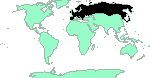 EU - Russia, Japan. See [maps]
Vielzahn-Johanniskrauteule
Purple Cloud
Hammaskuismayökkönen
EU - Russia, Japan. See [maps]
Vielzahn-Johanniskrauteule
Purple Cloud
Hammaskuismayökkönen
![[polyodon-1.jpg]](https://ftp.funet.fi/index/Tree_of_life/insecta/lepidoptera/ditrysia/noctuoidea/noctuidae/xyleninae/actinotia/_polyodon-1.jpg) 508x559 (~30Kb) Germany, Baden-Württemberg, Schönenberg, Siedlungsbereich (8°49'E, 48°57'N, 250m), 30.07.2001, Photo © Karl Hofsäß
508x559 (~30Kb) Germany, Baden-Württemberg, Schönenberg, Siedlungsbereich (8°49'E, 48°57'N, 250m), 30.07.2001, Photo © Karl Hofsäß
|
![[polyodon-2.jpg]](https://ftp.funet.fi/index/Tree_of_life/insecta/lepidoptera/ditrysia/noctuoidea/noctuidae/xyleninae/actinotia/_polyodon-2.jpg) 834x708 (~126Kb) Russia, Moscow area, 27.7.2010 (36°25'E, 56°23'N), Photo © D. Smirnov
834x708 (~126Kb) Russia, Moscow area, 27.7.2010 (36°25'E, 56°23'N), Photo © D. Smirnov
|
![[polyodon.jpg]](https://ftp.funet.fi/index/Tree_of_life/insecta/lepidoptera/ditrysia/noctuoidea/noctuidae/xyleninae/actinotia/_polyodon.jpg) 500x520 (~44Kb) FINLAND: Ka: Virolahti, 671:53, m+f 10-16.6.1995, Markku Savela leg.
500x520 (~44Kb) FINLAND: Ka: Virolahti, 671:53, m+f 10-16.6.1995, Markku Savela leg.
|
Larva on (in flowers and pods) Hypericum , H. maculatum, H. perforatum [SPRK]
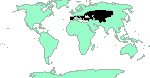 SEU, Turkey, Armenia, Turkmenistan, C.Asia. See [maps]
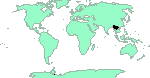 N.Vietnam. See [maps]
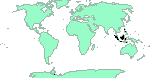 Borneo, Sulawesi. See [maps]
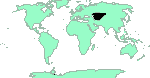 W.Turkestan. See [maps]
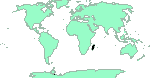 Madagascar. See [maps]
11.6.2023 (9)
If you are a computer science student or a self-taught programmer, you know the struggle. You need a resource that doesn't just show you what a stack or a queue is, but how it works under the hood using memory management and pointers.
Disclaimer: This blog post does not host or provide direct download links to copyrighted PDFs. It is intended for educational discussion and review purposes. Data Structures Through C In Depth Sk Srivastava Pdf
⭐⭐⭐⭐ (4.5/5) Lost half a star for occasional typographical errors in older prints, but the logic is rock solid. Have you used the S.K. Srivastava book? Let us know in the comments which data structure you found most difficult to implement in C! If you are a computer science student or
ptr = head; while (ptr->link != NULL) ptr = ptr->link; ptr->link = temp; } If you are preparing for a coding interview or a university exam (like VTU, AKTU, or B.Sc. CS), "Data Structures Through C In Depth" is a solid weapon. It is intended for educational discussion and review
For decades, the go-to language for understanding the raw logic of Data Structures has been . And one book that has quietly remained a student favorite is "Data Structures Through C In Depth" by S.K. Srivastava and Deepali Srivastava .
But why is this specific book (and its PDF version) so widely searched for? Let’s dive in. Most beginner books treat data structures like magic black boxes. You learn to call push() and pop() , but you never truly grasp the pointers moving behind the scenes.
// Typical style from the book: Clear, commented, and robust. struct node { int data; struct node *link; }; void insert_at_end(struct node *head, int info) { struct node *ptr, *temp; temp = malloc(sizeof(struct node)); temp->data = info; temp->link = NULL;
If you are a computer science student or a self-taught programmer, you know the struggle. You need a resource that doesn't just show you what a stack or a queue is, but how it works under the hood using memory management and pointers.
Disclaimer: This blog post does not host or provide direct download links to copyrighted PDFs. It is intended for educational discussion and review purposes.
⭐⭐⭐⭐ (4.5/5) Lost half a star for occasional typographical errors in older prints, but the logic is rock solid. Have you used the S.K. Srivastava book? Let us know in the comments which data structure you found most difficult to implement in C!
ptr = head; while (ptr->link != NULL) ptr = ptr->link; ptr->link = temp; } If you are preparing for a coding interview or a university exam (like VTU, AKTU, or B.Sc. CS), "Data Structures Through C In Depth" is a solid weapon.
For decades, the go-to language for understanding the raw logic of Data Structures has been . And one book that has quietly remained a student favorite is "Data Structures Through C In Depth" by S.K. Srivastava and Deepali Srivastava .
But why is this specific book (and its PDF version) so widely searched for? Let’s dive in. Most beginner books treat data structures like magic black boxes. You learn to call push() and pop() , but you never truly grasp the pointers moving behind the scenes.
// Typical style from the book: Clear, commented, and robust. struct node { int data; struct node *link; }; void insert_at_end(struct node *head, int info) { struct node *ptr, *temp; temp = malloc(sizeof(struct node)); temp->data = info; temp->link = NULL;
If you have corrections, comments or
information to add into these pages, just send mail to
Markku Savela
Keep in mind that the taxonomic information is copied from various sources, and may include many inaccuracies. Expert help is welcome.