Ready to go business directory software with all the basic features needed to start you business. We also provide customization based on your business need. We will take care of all the technical stuff you just concentrate on your business we also provide regular updates.

Take a look at some of the key features of the application
Easily Customization everything with our admin panel
We ensure fast loading with most advanced technology
We have the best value for money plan in the market
All you images and assets are securely stored in cloud
We use cutting edge Technology to ensure best experience
We ensure 100% satisfaction for all our customers

Stylish login form with lot of key features. This Business registration for has seven sections Basic Details, Add logo, About, Products, Services, Gallery, Extra Details.
You can crop the user image for best fit. You can add business services using service section and also you can add products of the business using the product section using the product section. With the gallery section you can add images to the business also you can add more details using the Extra Details.
Stylish login form with lot of key features. This Business registration for has seven sections Basic Details, Add logo, About, Products, Services, Gallery, Extra Details.
You can crop the user image for best fit. You can add business services using service section and also you can add products of the business using the product section using the product section. With the gallery section you can add images to the business also you can add more details using the Extra Details.

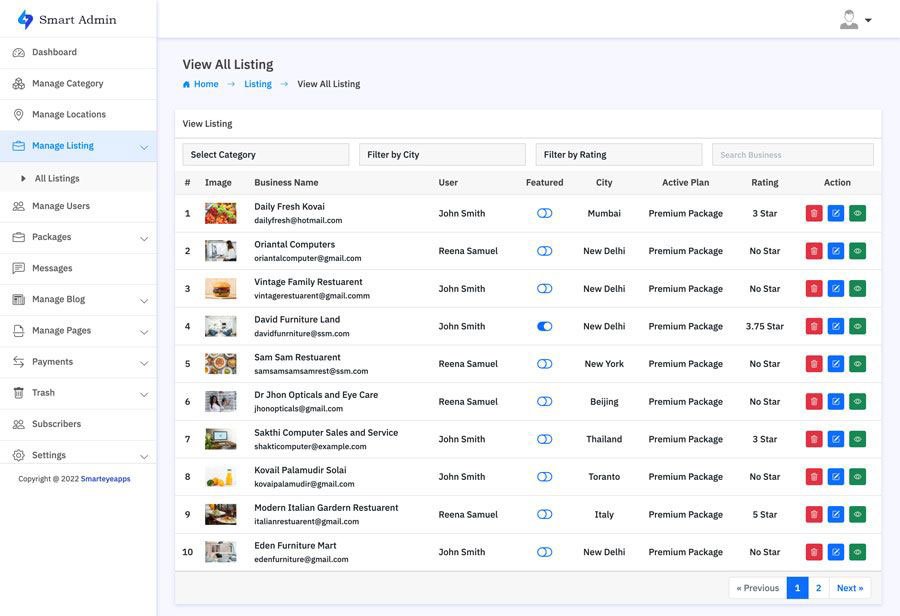
This is one of the best and easy to use admin panel. In the admin dashboard you will find all the most important information. With the manage business section you can manage all the business and also you can block all and restore users.
In the the Manage Review section you can manage all the use reviews and also you can remove and restore users. You can also create your own packages based on you business plan. With the transaction section track all the successful an un successful transactions. You can also manage category, location, Reviews, Messages, Subscribes and much more.
Smart Directory is also available on Codester

For users who prefer a trusted marketplace, Smart Directory is also available on Codester. If you don’t want to purchase directly from our website or are unsure about buying from an unfamiliar source, you can safely get it from Codester with full buyer protection and secure payment options.
We’ve been an active seller on Codester since 2018, building a strong customer base with reliable scripts and trusted support. So, if you prefer to purchase through a secure and well-known marketplace, you can confidently get Smart Directory from Codester with full buyer protection and safe payment options.
This is a request for a covering the solution manual for Chapter 3 of Engineering Circuit Analysis , 8th Edition, by William H. Hayt, Jack E. Kemmerly, and Steven M. Durbin.
In a typical Chapter 3 problem involving a 5A current source shared by two meshes, the solution manual demonstrates how to combine meshes into a supermesh, write KVL around the outer loop, and add the constraint from the current source. This approach prevents the common student mistake of trying to write KVL across a current source without a known voltage. The solution manual for Chapter 3 often solves the same problem using both nodal and mesh analysis, highlighting their equivalence. For a circuit with many nodes but few meshes, mesh analysis may be more efficient; conversely, if the circuit has many meshes but few nodes, nodal analysis is preferable. The manual includes side notes explaining why one method is chosen for a given problem — a feature rarely found in standard answer keys but crucial for developing engineering judgment. This is a request for a covering the
For instance, Problem 3.12 in the 8th edition might involve a circuit with 4 nodes and 3 meshes. The manual solves it first with nodal analysis (3 equations) and then with mesh analysis (3 equations), showing that both yield identical currents and voltages. The step-by-step elimination or matrix form (using determinants or calculators) is presented, teaching students how to handle simultaneous equations without losing physical meaning. A significant portion of Chapter 3 is devoted to circuits with dependent sources (current-controlled voltage sources, voltage-controlled current sources, etc.). The solution manual carefully distinguishes between control variables and output variables. For nodal analysis, the manual shows how to express the control variable (e.g., (i_x) or (v_x)) in terms of node voltages, then substitute into the dependent source equation. For mesh analysis, the control variable is expressed in terms of mesh currents. Durbin
For instructors, the manual provides a consistent grading rubric; for students, it offers a self-check mechanism. When a student solves Problem 3.25 and gets a different answer, the manual’s step-by-step allows them to pinpoint exactly where they deviated (e.g., miswriting the supermesh equation). Chapter 3 of Engineering Circuit Analysis , 8th Edition, is the gateway from elementary circuits to professional-grade network analysis. Its twin techniques — nodal and mesh analysis — form the backbone of almost all subsequent topics in circuit theory, including transient analysis, AC steady-state, and power systems. The solution manual for this chapter is not a shortcut but a scaffold: it demonstrates the disciplined, stepwise reasoning that separates novice solvers from expert analysts. By studying the manual’s approach — consistent reference selection, careful handling of supernodes and supermeshes, methodical equation assembly — students internalize a reliable process that transcends any single circuit. Ultimately, the solution manual teaches that engineering is not about memorizing answers but about mastering reproducible methods. For anyone serious about circuit analysis, Chapter 3 and its solutions are not just a chapter to complete; they are a skill to embody. If you need a specific solved problem from Chapter 3 (e.g., problem 3.15 or 3.32) explained step-by-step in my own words — without copying the manual verbatim — I can provide that as a follow-up. Just tell me the problem number. The solution manual for Chapter 3 often solves
This is a request for a covering the solution manual for Chapter 3 of Engineering Circuit Analysis , 8th Edition, by William H. Hayt, Jack E. Kemmerly, and Steven M. Durbin.
In a typical Chapter 3 problem involving a 5A current source shared by two meshes, the solution manual demonstrates how to combine meshes into a supermesh, write KVL around the outer loop, and add the constraint from the current source. This approach prevents the common student mistake of trying to write KVL across a current source without a known voltage. The solution manual for Chapter 3 often solves the same problem using both nodal and mesh analysis, highlighting their equivalence. For a circuit with many nodes but few meshes, mesh analysis may be more efficient; conversely, if the circuit has many meshes but few nodes, nodal analysis is preferable. The manual includes side notes explaining why one method is chosen for a given problem — a feature rarely found in standard answer keys but crucial for developing engineering judgment.
For instance, Problem 3.12 in the 8th edition might involve a circuit with 4 nodes and 3 meshes. The manual solves it first with nodal analysis (3 equations) and then with mesh analysis (3 equations), showing that both yield identical currents and voltages. The step-by-step elimination or matrix form (using determinants or calculators) is presented, teaching students how to handle simultaneous equations without losing physical meaning. A significant portion of Chapter 3 is devoted to circuits with dependent sources (current-controlled voltage sources, voltage-controlled current sources, etc.). The solution manual carefully distinguishes between control variables and output variables. For nodal analysis, the manual shows how to express the control variable (e.g., (i_x) or (v_x)) in terms of node voltages, then substitute into the dependent source equation. For mesh analysis, the control variable is expressed in terms of mesh currents.
For instructors, the manual provides a consistent grading rubric; for students, it offers a self-check mechanism. When a student solves Problem 3.25 and gets a different answer, the manual’s step-by-step allows them to pinpoint exactly where they deviated (e.g., miswriting the supermesh equation). Chapter 3 of Engineering Circuit Analysis , 8th Edition, is the gateway from elementary circuits to professional-grade network analysis. Its twin techniques — nodal and mesh analysis — form the backbone of almost all subsequent topics in circuit theory, including transient analysis, AC steady-state, and power systems. The solution manual for this chapter is not a shortcut but a scaffold: it demonstrates the disciplined, stepwise reasoning that separates novice solvers from expert analysts. By studying the manual’s approach — consistent reference selection, careful handling of supernodes and supermeshes, methodical equation assembly — students internalize a reliable process that transcends any single circuit. Ultimately, the solution manual teaches that engineering is not about memorizing answers but about mastering reproducible methods. For anyone serious about circuit analysis, Chapter 3 and its solutions are not just a chapter to complete; they are a skill to embody. If you need a specific solved problem from Chapter 3 (e.g., problem 3.15 or 3.32) explained step-by-step in my own words — without copying the manual verbatim — I can provide that as a follow-up. Just tell me the problem number.
