The first challenge in searching for "Nancy Ace" is determining whether the subject exists as a verifiable entity or as a phantom of fragmented memory. The name itself carries generic components: "Nancy" is a common first name, and "Ace" could be a surname, a nickname, or a brand. Without context—such as a known film title, a co-star, or a release year—the search engine is forced to cast a wide net. The user’s specification of "All Categories" suggests an initial strategy of maximum inclusivity, scanning news, web pages, images, videos, and shopping results before filtering down to "Movies." This approach is sound in theory but often yields high noise-to-signal ratios, returning results for unrelated individuals (e.g., Nancy from the Ace Ventura films) or generic uses of the word "ace" (e.g., "Nancy is an ace pilot").
Beyond the practical steps, the search for "Nancy Ace" serves as a metaphor for how we construct knowledge online. The user’s initial fragmented query—"Searching for- nancy ace in-All CategoriesMovie..."—mirrors the way human memory works: associatively, non-linearly, and often with gaps. The hyphenation and ellipsis suggest an interrupted thought, a half-remembered name from a movie seen years ago. In this light, the search is not merely a data-retrieval task but an act of narrative reconstruction.
In the modern era, the act of searching for information has been reduced to a reflex—a few keystrokes, a click, and an answer appears. However, this apparent simplicity masks a complex reality. When presented with an ambiguous query—such as searching for the name "Nancy Ace" across "All Categories" with a particular emphasis on "Movie"—the user is thrust into a microcosm of digital literacy challenges. This essay explores the theoretical and practical journey of such a search, examining the hurdles of name ambiguity, the structure of database categorization, and the critical thinking required to distinguish fact from fiction in an age of information overload.
Searching for "Nancy Ace" across all categories with a focus on movies is, in essence, a case study in modern information literacy. It teaches that search engines are not oracles but tools that reflect the structure and limitations of the data we have collectively digitized. Whether the search ends in triumph (finding a 1998 direct-to-video thriller starring Nancy Ace) or frustration (concluding that the name is a confabulation), the process itself is valuable. It hones the researcher’s ability to formulate hypotheses, test them across diverse categories, and accept ambiguity. In an era where we are flooded with information, the true skill lies not in getting an answer, but in asking a better question—and knowing how to chase it across the sprawling, imperfect, yet magnificent library of human knowledge.
Searching For- Nancy Ace In-all Categoriesmovie... ⟶ [ ESSENTIAL ]
The first challenge in searching for "Nancy Ace" is determining whether the subject exists as a verifiable entity or as a phantom of fragmented memory. The name itself carries generic components: "Nancy" is a common first name, and "Ace" could be a surname, a nickname, or a brand. Without context—such as a known film title, a co-star, or a release year—the search engine is forced to cast a wide net. The user’s specification of "All Categories" suggests an initial strategy of maximum inclusivity, scanning news, web pages, images, videos, and shopping results before filtering down to "Movies." This approach is sound in theory but often yields high noise-to-signal ratios, returning results for unrelated individuals (e.g., Nancy from the Ace Ventura films) or generic uses of the word "ace" (e.g., "Nancy is an ace pilot").
Beyond the practical steps, the search for "Nancy Ace" serves as a metaphor for how we construct knowledge online. The user’s initial fragmented query—"Searching for- nancy ace in-All CategoriesMovie..."—mirrors the way human memory works: associatively, non-linearly, and often with gaps. The hyphenation and ellipsis suggest an interrupted thought, a half-remembered name from a movie seen years ago. In this light, the search is not merely a data-retrieval task but an act of narrative reconstruction. Searching for- nancy ace in-All CategoriesMovie...
In the modern era, the act of searching for information has been reduced to a reflex—a few keystrokes, a click, and an answer appears. However, this apparent simplicity masks a complex reality. When presented with an ambiguous query—such as searching for the name "Nancy Ace" across "All Categories" with a particular emphasis on "Movie"—the user is thrust into a microcosm of digital literacy challenges. This essay explores the theoretical and practical journey of such a search, examining the hurdles of name ambiguity, the structure of database categorization, and the critical thinking required to distinguish fact from fiction in an age of information overload. The first challenge in searching for "Nancy Ace"
Searching for "Nancy Ace" across all categories with a focus on movies is, in essence, a case study in modern information literacy. It teaches that search engines are not oracles but tools that reflect the structure and limitations of the data we have collectively digitized. Whether the search ends in triumph (finding a 1998 direct-to-video thriller starring Nancy Ace) or frustration (concluding that the name is a confabulation), the process itself is valuable. It hones the researcher’s ability to formulate hypotheses, test them across diverse categories, and accept ambiguity. In an era where we are flooded with information, the true skill lies not in getting an answer, but in asking a better question—and knowing how to chase it across the sprawling, imperfect, yet magnificent library of human knowledge. The user’s specification of "All Categories" suggests an
Personalized One on One Chats
Omegle's chat rooms are designed for intimate conversations between you and
your match. By focusing solely on you, it creates an immersive experience where your partner's undivided
attention is directed towards you. Moreover, the platform ensures that you won't be matched with the same
partner again, adding variety to your interactions.
Omegle Free Random Video Chat
You can use Omegle’s video chat for any purpose you like, just like
countless other people. At any given time, you can easily find tens of thousands of people online.
Therefore, there is no chance that you won’t find your perfect match.
Omegle on PC & Mobile
Whether you're using a desktop computer, mobile phone, or tablet, Omegle
works effortlessly across all web browsers. It ensures compatibility with various devices, allowing you to
access the platform from anywhere at any time.
What is Omegle?
Omegle is a popular random video chat platform utilized by millions of users worldwide to connect with online
chat partners. It serves as a versatile platform where people can forge new friendships, engage in
discussions, pursue dating opportunities, engage in flirting, or simply have lighthearted fun without any
commitments.
By utilizing Omegle, users gain access to a diverse pool of individuals who are seeking similar experiences.
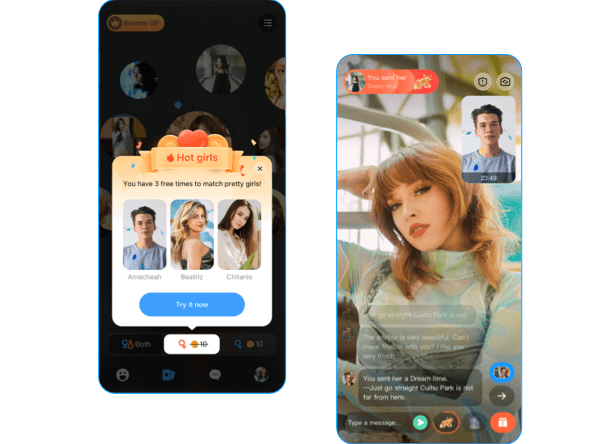
The platform offers the convenience of anonymous video chatting, allowing users to connect with girls with
just a single click, while maintaining complete anonymity. The matching process is swift and efficient,
facilitating a continuous stream of potential matches one after another.
![Random Video Chat Features]()

Start Video Chat